The Role of Magnetic Coupling in Vacuum Manipulators: Design and Benefits
Ultra-high vacuum (UHV) systems demand precise, reliable motion without compromising vacuum integrity or cleanliness. Whether you’re positioning samples for surface analysis, aligning substrates in thin film deposition, or manipulating components within complex research instruments, every moving part must be designed to perform flawlessly in extreme conditions. Magnetic coupling is one of the most effective ways to achieve this—offering contactless torque and linear motion transfer through the vacuum wall, with none of the drawbacks associated with traditional mechanical feedthroughs.
What Is Magnetic Coupling?
Magnetic coupling transfers motion between two separate components—typically one outside the vacuum chamber and one inside—using magnetic fields instead of direct mechanical contact. The magnetic arrays are arranged so that translation on the atmosphere-side magnet assembly induces corresponding motion on the vacuum-side assembly, even though the two are separated by a non-magnetic barrier (e.g. a stainless steel tube).
Why it matters for UHV:
- No dynamic seals: Because there’s no rotating shaft penetrating the chamber, there’s no need for lubricated bearings or rotary seals that could wear, outgas, or leak.
- Clean, contactless drive: Minimises particle generation associated with sliding or rolling interfaces and reduces contamination risk.
- Simple integration: Motion can be transmitted through a wide variety of devices to provide various independent motions.
How Magnetic Coupling Is Used in UHV Manipulators
Magnetic coupling appears in both rotary and linear UHV manipulators, and often in multi-axis assemblies.
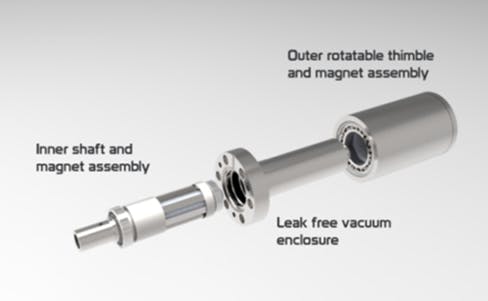
- Rotary or linear manipulators: The outside vacuum drive thimble couples to a in-vacuum shaft to provide linear and /or rotary motion. A wide variety of options are available so please contact UHV Design to discuss your requirement.
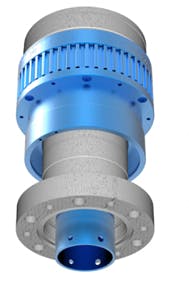
- Combined UHV Design stages: Some products can be stacked to provide multiple axes of rotation. In the below example, the red drive provides polar (axial) rotation of the main shaft, and the blue drive provides a secondary azimuthal axis of rotation. This assembly allows for linear, polar and azimuthal rotation as well as heating and biasing of a customer’s sample.
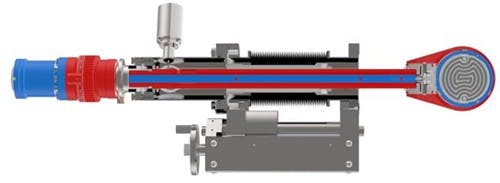
- Combined UHV Design stages: Customer often incorporate these products into their own bespoke designs to provide complex motions, such as grippers.
Key Benefits of Magnetic Coupling in UHV
1) Vacuum Integrity
Magnetic couplings remove one of the main risk points in UHV systems: dynamic feedthroughs. Without rotating shafts or sliding seals penetrating the chamber, leak paths are minimized, and long-term vacuum performance is more stable.
2) Clean Operation & Low Particle Generation
Because motion transfer is contactless across the wall, there’s no seal friction and significantly less particulate generation. This is especially valuable in contamination-sensitive applications like surface science (where monolayer cleanliness is essential) and thin film deposition (where particles can ruin film quality or yield).
3) Reduced Maintenance
No seal wear means fewer service interventions. You avoid scheduled seal replacements, re-lubrication, and the downstream risks of degraded vacuum due to seal aging—all of which lower total cost of ownership.
4) Reliability and Long Life
Permanent magnet couplings are inherently robust. With proper bearing selection on the vacuum side and quality motion control on the atmosphere side, systems can run for decades with consistent performance.
5) Bakeable magnets
UHV Design products are bakeable to 250C as standard. This means that the magnets do not need to be removed for bakeout and so the coupling strength can be maximised so provide the best coupling strength for each product size.
6) Shielded to contain magnetic field
At a distance of 50mm from each drive’s magnetic assembly the magnetic field is typically less than 200mgauss (less than half of the Earth’s magnetic field strength).
Where Magnetic Coupling Shines: Common Applications
- Surface Science / ARPES / STM: Clean rotation and linear motion for sample manipulation without introducing noise or contamination that could disrupt measurements.
- Thin Film Deposition (e.g., GLAD, sputtering, evaporation): Precise rotation/tilt of substrates to control columnar growth and film morphology; reduced contamination helps achieve high-quality films.
- Semiconductor & Nanotechnology: Reliable movement in cluster tools or transfer systems where uptime and cleanliness drive yield.
- Cryogenic / High-Temperature Environments: Magnetic couplings minimize failure modes associated with seals at extreme temperatures; also reduce lubricant challenges.
- Load Locks & Transfer Systems: Repeatable actuation for inserting/removing samples with robust vacuum isolation and minimal maintenance.
Conclusion
Magnetic coupling is a cornerstone of modern UHV manipulator design. By delivering contactless motion transfer through the chamber wall, it preserves vacuum integrity, reduces maintenance, and supports clean, precise operation—making it ideal for demanding research and industrial applications. When combined with the right bearings, encoders, and motion controls, magnetic-coupled manipulators can offer long service life, high reliability, and excellent repeatability across a broad range of use cases.
If you’re planning a new system or upgrading an existing tool, we’d be happy to help you select the right magnetic coupling architecture and motion stack for your application. Get in touch with UHV Design’s engineers to discuss your requirements, or explore our product range to see how our manipulators and stages can support your next experiment or process.