Why Vacuum Manipulators Experience Performance Issues and How to Avoid Them
Vacuum manipulators are designed to provide reliable and repeatable motion in demanding environments. When properly specified, installed and maintained, they can deliver many years of service with minimal intervention.
However, many performance issues are not caused by faults within the manipulator itself. Instead, they often arise from how the product has been integrated into the wider system, the operating conditions, or maintenance practices.
Understanding these common causes of performance issues can help improve reliability, reduce downtime and maximise service life.
Excessive Loads and Side Loading
One of the most common causes of vacuum manipulator problems is applying loads beyond the intended design limits.
While engineers often consider the weight being moved, side loads are frequently overlooked. Long probe assemblies, unsupported tooling, or loads applied away from the centreline can place significant forces on bearings, guides and drive mechanisms.
Typical symptoms include:
- Increased operating force
- Rough or inconsistent movement
- Reduced positioning accuracy
- Premature wear of bearings and drive components
- Missed steps on motorised systems
For motorised systems, excessive loads can increase the torque required to move the mechanism. As the required torque approaches the motor's capability, missed steps can occur, resulting in positional inaccuracies and reduced repeatability.
When assessing loads, it is important to consider not only the weight being moved, but also bending moments, side loads, dynamic forces and any additional loads that may be introduced during operation.
Incorrect Mechanical Support and System Integration
A vacuum manipulator should not be expected to compensate for poor support elsewhere in the system.
Both external and in-vacuum support arrangements must be considered during system design.
Outside the vacuum chamber, products may be over-supported, under-supported, or not adequately supported at all. Inside the vacuum chamber, long probes, instrumentation assemblies and extended shafts can create significant cantilevered loads.
While a manipulator may support these loads within its specification, some applications may require additional support within the vacuum system to minimise bearing loads and ensure the system performs as intended.
Conversely, over-supporting a system can also create problems. If supports introduce misalignment or constrain natural movement, the resulting stresses can lead to rough operation, increased friction and accelerated wear.
Typical symptoms include:
- Increased friction
- Rough or inconsistent movement
- Difficulty reaching target positions
- Premature bearing wear
- Reduced repeatability
1, Real-world example: Over-supported probe assembly
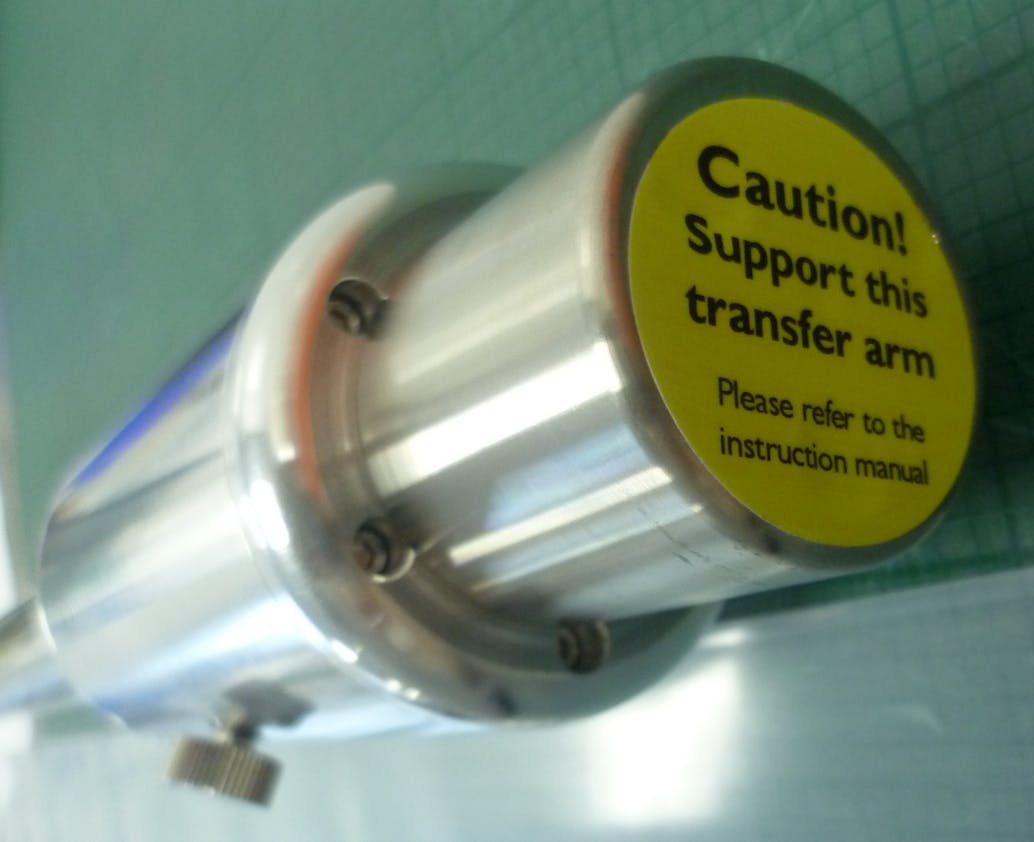
A customer reported severe juddering movement on a motorised Power Probe transfer arm. Initial investigations focused on the drive mechanism itself, however the root cause was eventually found elsewhere in the installation.
The rear of the system had been over-supported, causing the body tube to bow slightly during operation. This resulted in rough, inconsistent movement.
Once the support arrangement was corrected, the manipulator returned to normal operation.
Over constrained System Designs
Vacuum motion systems require a degree of flexibility to accommodate manufacturing tolerances, thermal expansion, gravity effects and minor alignment variations.
Problems often occur when connected mechanisms are rigidly constrained with no provision for movement elsewhere in the system. For example, extended shafts connected directly to external equipment without suitable bellows couplings or flexures can create unwanted loads.
Even very small alignment changes can produce significant forces when there is no compliance in the system.
Potential consequences include:
- Rough movement
- Increased drive loads
- Premature bearing wear
- Missed motor steps
- Positioning inaccuracies
2, Real-world example: Repeated bearing failures
One customer experienced repeated failures of a rear bearing across multiple systems. Replacing the bearing temporarily resolved the issue, but the failures continued to occur.
A detailed review of the installation revealed that a rigid extension shaft had been connected to the drive. Small misalignments elsewhere in the machine could not be absorbed and were instead transmitted directly into the bearing arrangement.
By introducing suitable compliance into the drive train, the excessive bearing loads were removed and the recurring failures disappeared.
Operating Against End Stops
Another common design mistake is requiring virtually all of the available travel from a manipulator.
When the required operating position is extremely close to the maximum stroke, small changes in alignment, assembly tolerances or thermal movement can result in the mechanism repeatedly striking the end of travel.
Repeated impacts can lead to:
- Bent leadscrews
- Damaged limit switches
- Adjustable switches being forced out of position
- Reduced positioning accuracy
Where possible, sufficient travel margin should be designed into the system so that normal operation occurs comfortably away from the mechanical limits.
3, Real-world example: Every last millimetre of travel
A customer reported a grinding noise and occasional ‘clunk’ when their manipulator reached full extension, describing the issue as occurring during the final few millimetres of travel.
Investigation showed that the application required effectively the full available travel. In practice, the control system was attempting to drive slightly beyond the available stroke in order to reach the required position.
As a result, the mechanism was operating beyond the intended switch positions and repeatedly contacting the hard stops. The repeated impacts generated the reported noise and created a risk of damage to switches and mechanical components.
Allowing adequate travel margin resolved the issue.
Process Contamination and Material Compatibility
The operating environment can have a significant impact on manipulator performance.
Processes such as CVD and other deposition techniques can generate contamination that gradually accumulates on moving components. Over time, these deposits can increase friction, generate particulates and eventually cause mechanisms to seize.
Material compatibility is equally important. Exposure to incompatible chemicals, process gases or operating conditions can accelerate degradation and lead to premature component failure.
Common symptoms include:
- Increasing operating force
- Irregular movement
- Seized mechanisms
- Particle generation
- Component degradation
Contamination risks should always be considered during both product selection and system design.
Operating Temperature and Bakeout Conditions
Temperature limits exist for a reason.
While many vacuum manipulators can tolerate elevated temperatures under specific conditions, operating beyond specified limits may affect materials, lubrication and overall performance.
Most UHV Design products are capable of withstanding bakeout temperatures up to 250°C when motors, pneumatic actuators and other temperature-sensitive components have been removed. However, these same systems are typically intended to operate at ambient temperatures during normal use.
Repeated bakeout cycles can also accelerate lubricant degradation and increase maintenance requirements.
Before operating at elevated temperatures, it is important to confirm that all components within the system are suitable for the intended conditions.
Excessive Speed and Duty Cycle
Running a manipulator faster or more frequently than intended can significantly reduce service life.
Higher operating speeds increase wear on leadscrews, nuts, bushes and bearings. In motorised systems, excessive loads combined with high speeds increase the likelihood of missed motor steps, reducing positioning accuracy.
Similarly, some applications require continuous operation where only intermittent operation was originally intended.
Typical symptoms include:
- Premature wear
- Reduced accuracy
- Increased vibration
- Missed motor steps
Expected operating speed and duty cycle should always be considered during product selection. If a product is found to be insufficient for a new requirement, we may be able to retrofit a different gearbox arrangement, or suggest changes to the construction.
Lack of Maintenance
Even the best-designed vacuum systems require routine maintenance.
Lubricants naturally degrade over time and can be affected by both operating conditions and bakeout cycles. As lubrication quality deteriorates, friction increases and wear rates can accelerate significantly.
Periodic inspection and re-greasing can often prevent more serious issues developing later.
Common indicators that maintenance may be required include:
- Increased operating force
- Rough movement
- Increased noise or vibration
- Reduced positioning repeatability
- Higher motor torque requirements
Where systems operate in demanding environments or experience frequent bakeout cycles, maintenance intervals may need to be shortened accordingly.
Early warning signs that should not be ignored
Many performance issues develop gradually rather than appearing suddenly.
Watch for:
- Increased operating force
- Rough or inconsistent movement
- Increased motor torque demand
- Missed motor steps
- Positioning inaccuracies
- Increased backlash
- Unexpected vibration or noise
- Difficulty reaching previously achievable positions
- Reduced repeatability
Addressing these symptoms early can often prevent more extensive repairs, unplanned downtime and higher maintenance costs.
Designing reliability into your Vacuum System
Most vacuum manipulator performance issues are not caused by manufacturing defects, but by the interaction between the manipulator and the wider system.
Factors such as loading, support arrangements, alignment, contamination, temperature, duty cycle and maintenance all have a significant influence on long-term reliability. Addressing these considerations during the design phase can dramatically improve performance and reduce lifetime ownership costs.
In many applications, seemingly minor details such as allowing additional travel margin, introducing flexibility into a drive train, correctly supporting long probe assemblies, or selecting materials compatible with the process environment can make the difference between years of reliable operation and recurring maintenance problems.
Where application requirements are particularly demanding, discussing the complete system with the equipment supplier during the specification stage can help identify potential risks before they become operational issues.
By considering the wider system, rather than focusing solely on the manipulator itself, engineers can maximise reliability, minimise downtime and achieve the long service life expected from high-performance vacuum motion equipment.
For more information or support, please contact sales@uhvdesign.com. Our team can review your application and discuss suitable options.