Bellows-Sealed and Magnetically Coupled Linear Actuators: A Practical Guide
Linear actuators are at the heart of nearly every ultra-high vacuum (UHV) system, driving sample movement, diagnostic insertion, shutter actuation, and countless other motion tasks. When specifying an actuator for a new system, one of the first and most consequential decisions an engineer makes is the sealing technology: bellows-sealed or magnetically coupled. Both deliver the leak-tight motion that UHV demands, but they solve the problem in fundamentally different ways — and choosing the wrong one can mean a system that falls short on stroke length, decouples under load, or wears out years before it should.
At UHV Design, we manufacture both technologies and have helped customers across surface science, accelerator physics, and semiconductor research specify the right solution. This guide walks through the key trade-offs.
Understanding the Two Technologies
Bellows-Sealed Actuators: Direct Mechanical Coupling
A bellows-sealed actuator uses a thin-walled, flexible metal bellows (typically edge-welded stainless steel) to physically separate atmosphere from vacuum. As the drive shaft translates, the bellows compresses and extends to follow it. The mechanical link between the external drive and the in-vacuum load is direct, rigid, and entirely contact-based.
Magnetically Coupled Actuators: Force Through a Static Wall
A magnetically coupled actuator transmits motion through a permanent magnet array on the atmospheric side, which couples through a thin, non-magnetic vacuum wall to a follower array on the vacuum side. There is no moving seal (the vacuum boundary is a static tube) and the drive transmits force through the magnetic field rather than through metal.
Stroke Length: The First Practical Differentiator
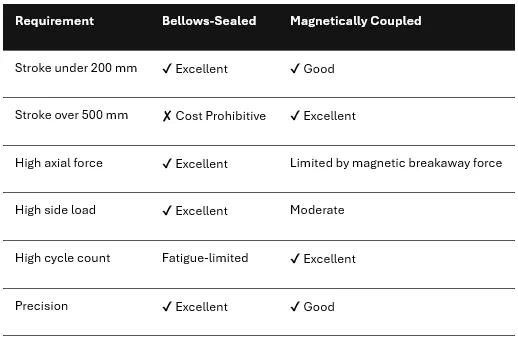
Bellows have a finite compression ratio, which physically limits how far they can travel before fatigue becomes a concern. Strokes beyond around 300 mm push the design envelope and start to drive up cost.
Magnetically coupled designs face no such limit. The follower can travel the full length of the guide tube, and strokes of 500 mm, 1 metre, or longer are routine. For long-stroke sample transfer between load locks and remote analysis chambers, magnetic coupling is almost always the right starting point.
Load Capacity and Stiffness
Bellows-sealed actuators win on stiffness. The direct mechanical coupling means there is no risk of decoupling under sudden load, and side loads are well tolerated. For applications requiring high axial force bellows are the safer choice.
Magnetic couplings have a defined breakaway force. Exceed it and the magnets slip, position is lost, and the operator has to recover the system. Modern designs offer impressive holding forces, but the limit must be respected at the specification stage.
Precision, Fatigue, and Service Life
Both technologies are capable of micron-scale repeatability when paired with the right drive and encoder. Bellows-sealed actuators have no risk of coupling slip, making them the gold standard for nanometre-scale work such as wire scanner positioning in free electron lasers.
However, bellows are a wearing component. Each cycle puts the welds through a fatigue load, and the cycle life (typically 10,000 to 100,000 full strokes) should be checked against the application's duty cycle. Magnetic couplings have no fatiguing seal, making them the better choice for high-cycle applications such as automated sample handling.
A Practical Decision Matrix
What makes UHV Design Linear Actuators a Strong Choice for Either Approach
- Comprehensive Range — Both bellows-sealed and magnetically coupled designs across a wide range of strokes and bore sizes.
- UHV Compatibility — All actuators are bakeable, low-outgassing, and designed for leak-tight performance at 10⁻¹⁰ mbar and beyond.
- Precision and Repeatability — Smooth, controllable motion with options for manual, motorised, and encoded drive.
- Integration with Complex Motion Assemblies — Combine with rotary feedthroughs, manipulators, and multiple-axis stages to build complete custom solutions.
- Proven in Demanding Environments — Widely deployed across synchrotron beamlines, surface science laboratories, and semiconductor research facilities.
Choosing With Confidence
Short, high-force, high-precision moves favour bellows. Long, high-cycle, transfer-style moves favour magnetic coupling. Anything ambiguous is worth discussing with an applications engineer before the chamber design is frozen.
UHV Design are specialists in ultra high vacuum components for heating and manipulation.
Conclusion
Choosing between bellows-sealed and magnetically coupled linear actuators is one of the most consequential decisions in any UHV system design. Each technology brings distinct strengths — bellows for stiffness, axial force, and nanometer precision; magnetic coupling for long strokes, high cycle counts, and contamination-free operation — and the best system is almost always the one that matches the sealing technology to the real motion demands of the application. When paired with the right guides, encoders, and drive options, either approach can deliver long service life, leak-tight performance, and the repeatability that demanding research and industrial users expect.
Whether you're designing a new vacuum system or optimising an existing process our engineers can help you select the most appropriate motion solution for your application. Get in touch to discuss your requirements, or explore our range of linear actuators, manipulators and motion stages to discover how UHV Design can support your next project.